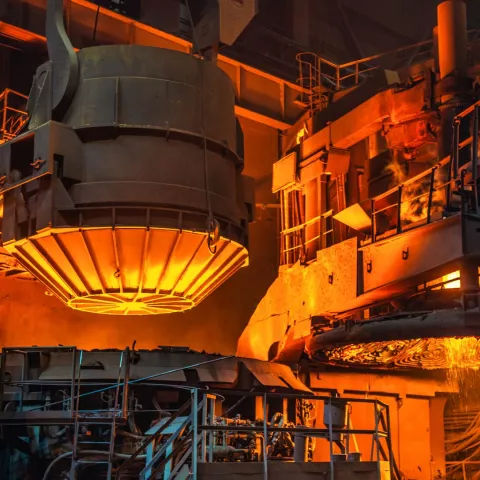
Iron ore agglomeration is essential to preparing fine ores for efficient use in blast furnaces and direct reduction processes. Whether through sintering or pelletization, this step enhances material handling, improves furnace performance, and supports consistent steel production.
At Lhoist, we supply calcium- and magnesium-based products - such as finely crushed limestone, dolomite, and specialty hydrated limes - that act as fluxes and binders. These additives help control basicity, improve sinter plant productivity, and enable the formation of high-quality pellets and slag, contributing to greater efficiency and mechanical strength in ironmaking.
In pellet plants, finely-crushed limestone and dolomite result in products with the desired basicity (ratio CaO + MgO vs. SiO2 ).
Pelletization involves the agglomeration of ultra-fine ores with other raw materials, such as coal, hydrated lime and limestone. Once the materials have been homogenized in suitable quantities (for ideal mass balance), the mixture is sent to a disc or a pelletization drum. The result is an 8 to 18-mm diameter pellet that is burned at approximately 1,350°C to increase its mechanical resistance. Certain specialty hydrated limes are an efficient alternative binder to high SiO2 bentonite.
Dolomite provides MgO which the process requires to achieve proper fluidity of blast furnace slag.